Geotechnical investigation in Milton, Ontario, addresses the complex subsurface conditions shaped by the Niagara Escarpment, glacial till deposits, and shale bedrock of the Queenston Formation. These programs are governed by the Ontario Building Code and must follow Canadian Foundation Engineering Manual guidelines to assess bearing capacity, settlement, and groundwater. Fieldwork often includes advanced in-situ testing such as the CPT (Cone Penetration Test), which provides continuous soil profiling and pore pressure data critical for foundation design in the variable Halton Till.
This category supports residential subdivisions, commercial developments, and infrastructure projects traversing the escarpment corridor. Integrating CPT data with laboratory analysis refines geotechnical models for cost-effective shoring and footing recommendations. Proper investigation mitigates risks of differential settlement and slope instability, ensuring compliance with municipal conservation authority requirements across Milton's expanding urban boundary.
A 15 m anchor bonded in Halton Till requires a completely different load-transfer model than a 5 m socket in Lockport dolostone.
Service characteristics in Milton Ontario
Local geotechnical conditions in Milton Ontario
Milton grew from a mill town on the Credit River into a logistics hub, and the pace of warehouse construction along James Snow Parkway has accelerated earth retention demands. The historical development masked a persistent risk: the shale bedrock in the southern tier weathers rapidly when exposed in an open excavation. A passive anchor designed with a 2 m bond in fresh shale can lose 40% of its capacity if the socket intersects a weathered seam. Our investigation protocol requires a minimum of three boreholes per retaining wall line, with the anchor bond zone confirmed by continuous rock coring rather than rotary percussion chips. Where the water table is perched within the till, the design shifts to a fully grouted active tendon with a post-tensioning sequence that accounts for the buoyant unit weight of the overburden. The retaining-walls analysis integrates the anchor stiffness directly into the soil-structure interaction model.
Our services
Anchor design in Milton moves between two distinct ground conditions — the competent dolostone of the Escarpment and the glacial till plains to the south. Each anchor type must be specified with a load-deformation behavior that matches the retention system stiffness.
Active Tieback Anchors for Deep Excavations
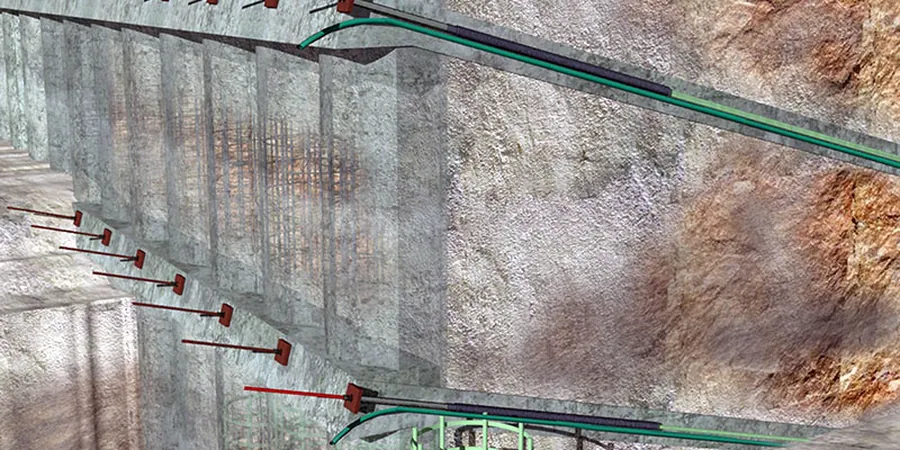
Post-tensioned multi-strand anchors for soldier pile and secant wall support systems. We design the unbonded length to place the fixed anchor beyond the active failure wedge, calculating the lock-off load at 80% of the design load to limit wall deflection in the sensitive Halton Till. Proof testing to ASTM D3689 is mandatory on 5% of production anchors.
Passive Bar Anchors for Permanent Rock Slope Stabilization
Fully grouted Grade 400W bars installed into the Amabel and Lockport formations. The bond length is verified by RQD and fracture spacing from oriented core. We specify double-corrosion protection for any anchor with a design life exceeding 24 months. The passive system activates through rock mass deformation, so the shear displacement compatibility with the slope movement rate is checked against the creep threshold.
Frequently asked questions
What is the typical cost range for an anchor design package in Milton?
For a project requiring 20 to 60 anchors with site investigation, load-testing specification, and stamped design drawings, the budget typically falls between CA$1,460 and CA$5,360. The spread depends on the number of boreholes needed, whether the anchors are active or passive, and the corrosion protection class specified.
How do you determine the bond length in the Lockport dolostone?
We use the rock mass classification from oriented core logging — RQD, fracture spacing, and infill condition — and apply the Littlejohn and Bruce (1977) bond stress model. The design bond stress is capped at 10% of the unconfined compressive strength of the intact rock. Each anchor type is proof-tested to ASTM D3689 with a 10-minute hold at the design load to confirm creep is below 2 mm per log cycle of time.
Can passive anchors be used in the Halton Till south of Britannia Road?
Passive anchors in till are rare because the bond stress is low and the creep deformation is high. In the till plains south of Milton, we typically specify active post-tensioned anchors with a fixed length embedded in the underlying shale or dolostone. If bedrock is deeper than 20 m, the retaining system is usually switched to a cantilever or braced excavation to avoid anchor creep failure.