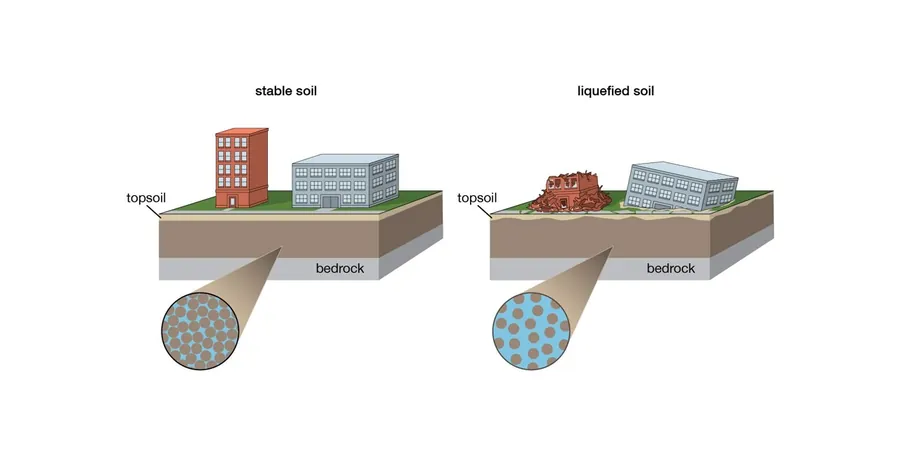
Milton sits roughly 200 meters above sea level at the base of the Niagara Escarpment, where the overburden of Halton Till and occasional sand seams creates a specific seismic profile that cannot be read from a generic map. The National Building Code of Canada requires a site-specific soil liquefaction analysis for any structure assigned to Site Class D, E, or F, and in Milton that often means confronting the loose sand pockets trapped beneath the dense till. When the 2015 version of the NBCC tightened the seismic hazard values for Southern Ontario, it pushed more projects into the territory where simplified procedures like the NCEER method trigger a mandatory assessment. Our laboratory runs the supporting index tests—grain size distribution and Atterberg limits—while field data from CPT testing or SPT borings feeds the cyclic resistance ratio calculations needed for a defensible report.
Liquefaction in Milton is controlled less by the regional seismicity and more by the discontinuous sand stringers hidden inside the Halton Till.
Service characteristics in Milton Ontario
Local geotechnical conditions in Milton Ontario
A five-storey mixed-use building proposed near the Britannia Road corridor hit a saturated fine sand lens at 4.8 metres during preliminary drilling. The contractor assumed bedrock was shallow because of the Escarpment proximity, but the grain size curve from the split spoon samples plotted squarely inside the liquefiable envelope. Without a soil liquefaction analysis, the original shallow footing design would have carried a post-earthquake settlement risk exceeding 75 mm under the M6.8 design event. The NBCC 2015 spectrum for Milton, with a PGA around 0.12g on firm ground, amplifies once you cross into Site Class D or E material, and that amplification is what triggers the factor of safety below 1.0 in the Youd-Idriss procedure. The project was re-engineered with ground improvement after the analysis quantified the residual strength loss, and that sequence—drill, test, model, reinforce—has become standard for any medium-rise on the south side of the 401.
Our services
A complete soil liquefaction analysis for a Milton site draws on field investigation, laboratory index testing, and numerical modeling tied to the NBCC spectrum. The three packages below cover the most common project triggers in the region.
SPT-Based Liquefaction Triggering
Full NCEER procedure using SPT blow counts corrected for overburden, energy ratio, and fines content. Includes factor of safety per layer and LPI contouring for the building footprint.
CPT-Based Continuous Profiling
High-resolution cyclic resistance assessment using corrected cone tip resistance and sleeve friction ratio. Ideal for sites where thin sand seams need to be detected between till layers.
Post-Liquefaction Settlement & Mitigation Screening
Tokimatsu-Seed volumetric strain integration across all liquefied layers, plus a screening matrix for vibrocompaction, stone columns, or rigid inclusions if the settlement exceeds project tolerances.
Frequently asked questions
How much does a soil liquefaction analysis cost for a typical Milton building lot?
For a standard residential or light commercial lot in Milton, a complete soil liquefaction analysis including field drilling, laboratory index testing, and the NCEER-based report typically ranges from CA$3,680 to CA$5,440. The final cost depends on the number of boreholes required and whether SPT or CPT data is used as the primary input.
Does every project in Milton need a liquefaction analysis?
Not every project. The NBCC triggers a soil liquefaction analysis when the site is classified as Site Class D, E, or F and the groundwater table is within 10 metres of the foundation level. Many Milton sites on dense Halton Till classify as Site Class C, but any borehole encountering loose sand below the water table changes that classification and makes the analysis mandatory.
What is the difference between the SPT-based and CPT-based liquefaction methods?
The SPT-based method relies on corrected blow counts from split-spoon samples and is well-suited for sites where soil samples are needed for index testing. The CPT-based method provides a continuous profile of tip resistance and sleeve friction, which is better at detecting thin sand seams that SPT might miss. Both follow the NCEER framework and produce comparable factors of safety when calibrated correctly.