A common misstep in Milton is assuming that standard fill compaction will suffice at depth when the site sits on 8 to 15 meters of loose glaciolacustrine sand overlying the Queenston shale bedrock. The difference between a well-settled slab and a differential settlement claim often traces back to whether the deep soil mass was densified before structural loads were applied. Vibrocompaction design addresses this directly: it establishes the grid spacing, probe energy, and duration required to achieve a target relative density, typically 70 to 85 percent, across the full treatment depth. In Halton Region, where water tables can fluctuate seasonally and the Niagara Escarpment influences drainage patterns, the design must also account for pore pressure dissipation rates during cyclic probe withdrawal. A properly calibrated CPT test before and after treatment provides the continuous tip resistance profile needed to verify that densification has reached the design elevation, while in-situ permeability testing helps predict consolidation times in silty interbeds that slow drainage during vibration.
The probe spacing in vibrocompaction is not a guess: it is back-calculated from the target relative density and the fines content of the formation.
Service characteristics in Milton Ontario
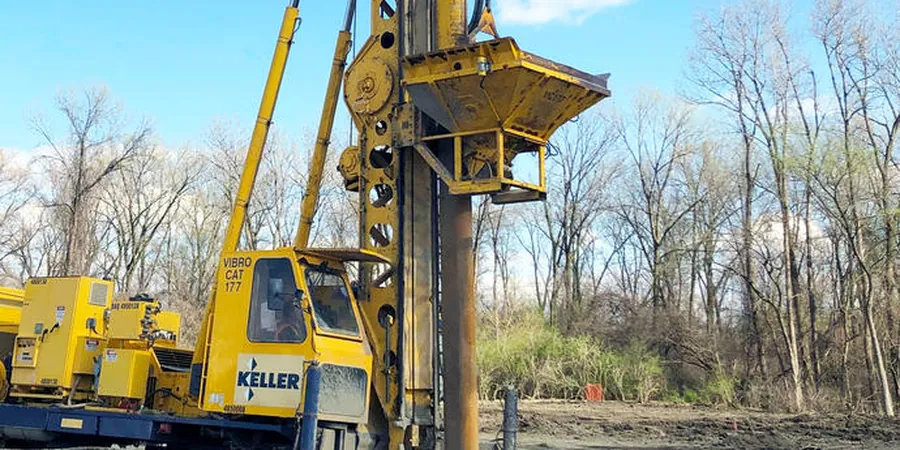
Demonstration video
Local geotechnical conditions in Milton Ontario
Milton's development history shifted from agricultural land to high-density suburban subdivisions in the early 2000s, with large tracts of former farmland along Britannia Road and Louis St. Laurent Avenue converted to residential and logistics uses. Many of these parcels were underlain by loose sand deposits that had never supported engineered fill loads. Without deep densification, the risk is not just settlement—it is differential settlement across the footprint, amplified by variable overburden thickness and post-construction groundwater rise. A vibrocompaction design that omits a site-specific liquefaction screening under the NBCC seismic hazard values for the Greater Toronto Area, which assigns Milton a PGA on firm ground of approximately 0.08g for a 2% in 50-year event, may leave the structure vulnerable to cyclic softening in saturated zones. The liquefaction assessment, using SPT or CPT-based triggering curves per Youd and Idriss (2001), must be embedded in the design brief from the outset. Our team has observed cases where post-treatment CPTs in northern Milton revealed a 40 to 60 percent increase in tip resistance over untreated values, confirming that the design energy input matched the soil response. Skipping this step leads to costly rework once floor slabs begin to crack.
Our services
Our vibrocompaction design package for Milton projects includes the following technical components, delivered with documentation ready for permit submission to the Town of Milton building department.
Grid Design and Energy Calibration
We determine the optimal triangular grid spacing based on pre-treatment CPT data and grain-size curves, specify probe type, centrifugal force, vibration frequency, and hold time at maximum depth, and calibrate the energy input to achieve a uniform relative density of 70–85% across the treatment zone.
Quality Control and Post-Treatment Verification
Post-densification CPT testing on a 15 m grid within the treated area to verify tip resistance improvement. We also perform before-and-after SPT comparisons at select locations and document the results against the design acceptance criteria defined in the project specifications.
Frequently asked questions
How much does vibrocompaction design cost for a typical Milton residential lot?
For a standard single-family lot in Milton, the vibrocompaction design package—including pre-treatment site characterization, grid layout, energy calibration, and post-treatment CPT verification—typically ranges from CA$1,740 to CA$6,380, depending on the treatment depth and the number of verification points required by the geotechnical engineer of record.
At what depth does vibrocompaction become less effective in Milton soils?
Effectiveness begins to decline below 18 to 20 meters in Milton's glaciolacustrine deposits, where overburden stress can exceed the probe's lateral displacement capacity. Below the Queenston shale contact, typically encountered between 8 and 15 meters in the southern part of town, densification is not applicable and alternative ground improvement methods should be considered.
How soon after vibrocompaction can foundation construction begin on a Milton site?
Construction can commence as soon as the post-treatment CPT verification confirms that the target tip resistance has been achieved and excess pore pressures have dissipated, which in Milton's sandy soils generally takes 24 to 72 hours after the last probe pass, depending on the silt content and drainage conditions at the specific site.