Milton sits right on the edge of the Niagara Escarpment, where shallow shale bedrock meets thick deposits of Halton Till. That mix creates a headache for foundation design: one lot might bear on competent rock while the next, only fifty feet away, punches through stiff clay with cobbles. A standard borehole can flag the transition, but it won't give you the continuous strength profile that a CPT delivers. We run cone penetration tests across Georgetown, Campbellville, and new subdivisions east of Highway 25 because the stratigraphy here changes faster than most engineers expect. Combining the CPT with a targeted SPT drilling program lets us calibrate tip resistance against local till behavior and avoid overconservative bearing values that inflate concrete costs.
Three channels of continuous data every centimetre — tip resistance, sleeve friction, and pore pressure — so no soft layer goes undetected.
Service characteristics in Milton Ontario
Local geotechnical conditions in Milton Ontario
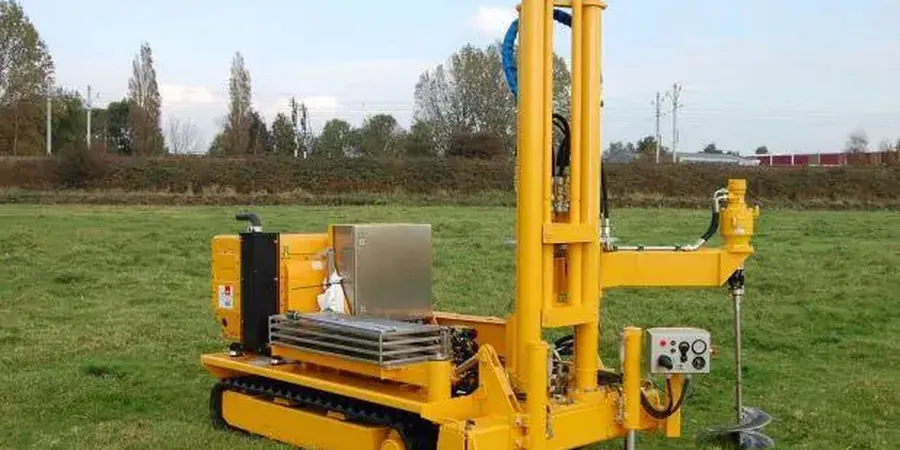
The CPT rig itself is a twenty-tonne truck with a hydraulic ram mounted inside the cab, pushing a steel cone at a constant two centimetres per second. In Milton's compact Halton Till, the reaction mass is usually enough to reach target depth without anchors, but boulder fields left by the last glaciation can stop the cone dead at unpredictable depths. When refusal happens early, the data still gives us an undrained shear strength profile for the upper zone, and we can switch to a mud-rotary borehole to punch through the obstruction. The bigger operational risk is pore pressure sensor saturation in dense silts near the escarpment face — if the filter element loses saturation, the u2 channel flatlines and the effective-stress interpretation becomes unreliable. Our crew saturates the element with glycerin before every push and monitors the baseline drift on screen, because a missed excess pore pressure spike can lead to an embankment design that looks stable on paper but fails during a wet spring.
Our services
Every CPT job we run in Milton includes digital data files, a stratigraphic log with soil behavior type, and interpreted engineering parameters. Beyond the standard cone, we offer these complementary services:
CPTu with pore pressure dissipation
Push-and-hold tests at target depths to measure the rate of excess pore pressure decay, giving consolidation coefficients for clay layers that control settlement timelines.
Seismic CPT (SCPT)
A geophone module behind the cone records shear-wave arrivals from a surface hammer strike, providing Vs profiles for NBCC site classification without a separate borehole.
CPT grouting add-on
If the cone log reveals loose zones at depth, we can grout through the same push rods, saving a second mobilization for compaction grouting or permeation treatment.
CPT-based pile capacity
Direct-design methods (LCPC, ICP-05) convert tip and friction data into axial pile resistance, reducing the number of static load tests required by the foundation contractor.
Frequently asked questions
How much does a CPT test cost in Milton?
For a standard CPT sounding in Milton, budget between CA$210 and CA$340 per metre pushed, depending on depth, access constraints, and whether pore pressure (CPTu) or seismic (SCPT) modules are needed. Mobilization to sites north of the 401 or west of Tremaine Road adds a fixed charge. We quote per project after reviewing the borehole plan and site access, and the price always includes the digital data file, soil behavior type log, and the signed engineering report.
What is the difference between CPT and SPT for Milton's soils?
The SPT gives you a blow count every 1.5 metres from a disturbed sample; the CPT gives you continuous, undisturbed readings of tip resistance, sleeve friction, and pore pressure every centimetre. In Milton's interbedded till and glaciolacustrine silts, the SPT can miss a 100 mm soft seam that controls slope stability, while the CPT captures it immediately. The tradeoff: SPT retrieves a physical sample for lab testing, so we often recommend three to four CPT soundings plus one calibrated SPT borehole rather than an all-CPT or all-SPT program.
How deep can a CPT rig penetrate in Halton Region?
In the clay till and silt plains around Milton, we typically reach 18 to 25 metres before hitting refusal on shale bedrock or dense boulder till. Sites close to the Niagara Escarpment often see refusal shallower — sometimes 3 to 6 metres — because the Queenston shale is near the surface. Our 20-tonne truck provides enough reaction for most sites, but if deeper penetration in dense material is critical, we can deploy a rig with helical anchor tie-downs to push past 30 metres.