Milton sits on the Niagara Escarpment's eastern edge, with over 42% of its land designated as rural and a population that has tripled since 2001. This rapid expansion onto escarpment terrain and glacial till means almost every major project needs a retaining wall design that accounts for variable bedrock depth and lateral earth pressures. We handle the full geotechnical scope: site investigation, bearing capacity under eccentric loading, global stability, and drainage design. Before finalizing wall dimensions, we often run an in-situ permeability test to confirm drainage assumptions in the Halton Till, and pair wall analysis with a slope stability model when the retained height exceeds 2.5 m.
A retaining wall in Milton has to shed perched groundwater on the shale before it builds pore pressure. Get the drainage wrong and the best reinforcement won't save it.
Service characteristics in Milton Ontario
- Gravity, cantilever, counterfort, and MSE wall types
- Drainage design for perched groundwater on shale bedrock
- Global stability analysis with SLOPE/W or Slide2
- Reinforced concrete detailing per CSA A23.3
- Segmental SRW connection and pullout verification
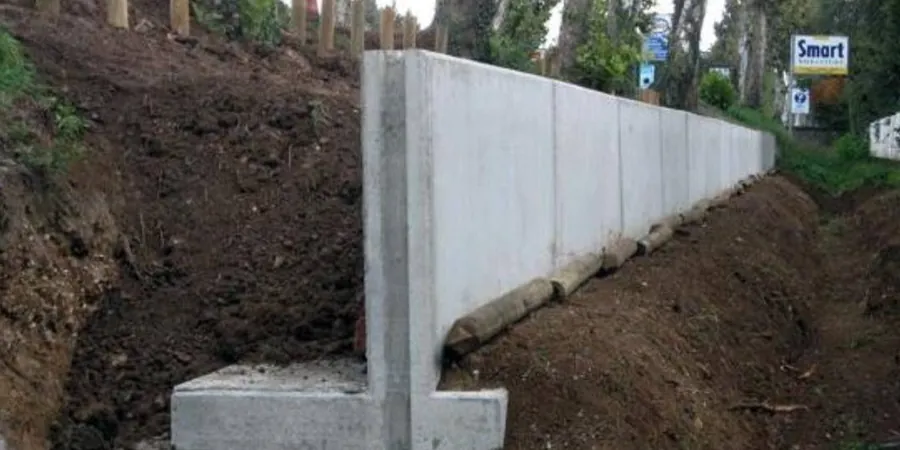
Local geotechnical conditions in Milton Ontario
Milton's developable land pushes up against the Escarpment, so cut-and-fill operations are routine. A poorly designed wall here fails in two ways: sliding along a slick shale interface after a wet spring, or rotational failure through the till when fill is placed without benching. We have seen walls tilt within two years because the contractor backfilled with frozen till in November. That is why our design packages include cold-weather placement restrictions and specify granular backfill gradation tighter than OPSS.MUNI 206. For walls retaining public right-of-way, we coordinate with the Town of Milton's engineering department to meet their retaining wall policy and stormwater management criteria, which often requires a separate hydrogeological assessment for cut walls deeper than 1.8 m.
Our services
Our retaining wall design scope covers the full project cycle, from borehole investigation through to construction review. Every wall type requires a different analytical approach, and we select the right model based on Milton's subsurface conditions.
Gravity and Cantilever Wall Design
Reinforced concrete stem and base slab analysis with bearing capacity on till or shale. We check eccentricity limits and size the heel to resist sliding, using drained strength parameters from lab testing.
MSE and Segmental Block Walls
Internal stability review for geogrid-reinforced systems: pullout capacity in Halton Till, connection strength at the facing, and global compound stability with the retained slope.
Drainage System Design
Perched groundwater on the shale requires a continuous drainage blanket, toe drains, and weep holes spaced to keep the phreatic surface below the wall base. We specify filter fabric and granular drain materials per OPSS standards.
Construction Review and Instrumentation
On-site review during backfill placement and compaction. We verify lift thickness, moisture content, and drainage layer continuity. For critical walls, we specify inclinometer casing behind the wall to monitor long-term deflection.
Frequently asked questions
What retaining wall types are most suitable for Milton's clay till?
Reinforced concrete cantilever walls and MSE walls work well in Halton Till when founded below the frost depth of 1.2 m. Gravity walls can be economical for heights under 2 m if a granular pad is placed. The key is drainage: the till has low permeability, so a continuous drainage blanket behind the wall is non-negotiable.
Do I need a building permit for a retaining wall in Milton?
The Town of Milton requires a permit for retaining walls over 1.0 m in height, or any wall supporting a surcharge from a building or driveway. Walls over 1.8 m must be designed and sealed by a licensed professional engineer in Ontario, which we provide as part of the design package.
How much does retaining wall design cost for a residential project in Milton?
For a typical residential retaining wall in Milton, the engineering design fee ranges from CA$1,330 to CA$5,990 depending on wall height, length, and whether a soil investigation is already available. A site visit and geotechnical borehole add to the scope if existing data is insufficient.
How do you handle the perched groundwater on the Queenston Shale?
We model the shale surface as an inclined low-permeability boundary and design a drainage system to intercept flow before it reaches the wall. This usually means a granular chimney drain with a perforated collector at the base, plus weep holes at 1.5 m spacing. We also check the wall for hydrostatic loading as a contingency if drains clog over time.