A 6-storey mixed-use building on Bronte Street South ran into trouble last year. The boreholes hit something unexpected at 14 meters: a dense silt till with cobbles, right where the parking garage was going. Standard SPT numbers looked fine, but the designer needed real strength parameters—cohesion and friction angle—to finalize the footing sizes. That’s when the triaxial test becomes non-negotiable. In Milton, we deal with Halton Till, glaciolacustrine silts, and the occasional shale bedrock pocket near the escarpment. Each behaves differently under load. The triaxial test gives you the drained and undrained shear strength needed for bearing capacity calculations, not just index correlations. For complex sites, we often pair the triaxial with CPT testing to map stratigraphy continuously before sampling, and use grain size analysis to confirm the silt-sand-clay fractions that control drainage behavior.
An overconsolidated till in Milton can lose 40 percent of its undrained strength if you don't account for fissures during specimen preparation.
Service characteristics in Milton Ontario
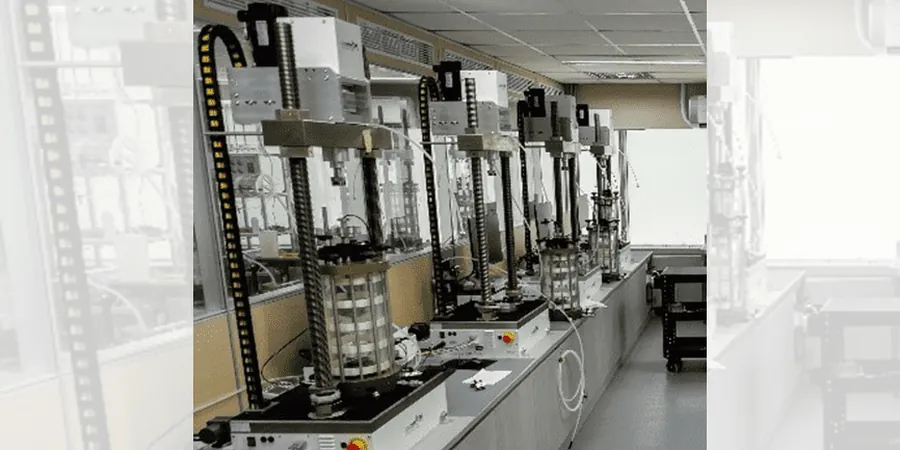
Local geotechnical conditions in Milton Ontario
Milton's growth since the early 2000s—doubling its population in 20 years—pushed development into areas that were farmland or wetland a generation ago. The Boyne Survey lands and the Derry Green Business Park sit on compressible silts that were never meant to carry heavy structures. Skipping the triaxial test in these zones means you are guessing the consolidation state. An overconsolidated silt can look stiff in the field but generate positive pore pressure during undrained loading, dropping its shear strength below what the bearing capacity formula assumes. We have seen footings designed with a friction angle of 32 degrees fail to meet the Factor of Safety when the actual drained angle from a CD triaxial came back at 26 degrees. That gap is the difference between a mat foundation at 500 mm thick and one at 800 mm. In Milton's seismic zone (NBCC 2020 Sa(0.2) around 0.35 g), the cyclic strength from triaxial testing also feeds into liquefaction assessments for deep foundations.
Our services
Our Milton triaxial program covers three test configurations. Each answers a specific design question.
Unconsolidated-Undrained (UU) Triaxial
For short-term bearing capacity in saturated, low-permeability soils like the Halton Till. Specimens are not consolidated before shear. We run three specimens at different confining pressures to define the undrained strength envelope. Typical turnaround: 5 business days from sample receipt.
Consolidated-Undrained (CU) Triaxial with Pore Pressure
For effective stress analysis. Specimens are consolidated to in-situ stress, then sheared undrained while measuring excess pore pressure. Used for slope stability and embankment design where long-term drainage changes the stress state. Full p-q diagrams included.
Consolidated-Drained (CD) Triaxial
For long-term drained friction angle. Shear rate is slow enough to prevent pore pressure buildup. Essential for retaining wall design and deep excavations in granular soils. We also run CD tests on compacted fill to verify Proctor-based specifications.
Frequently asked questions
How much does a triaxial test cost in Milton?
A full triaxial test program (three specimens, one set) runs between CA$2,330 and CA$4,190 depending on the type—UU is the most economical, CU with pore pressure measurement falls in the mid-range, and CD testing with its slower shear rates is at the higher end. The price includes specimen trimming, saturation, consolidation, shearing, and the final report with Mohr-Coulomb parameters.
How long does a triaxial test take from sample to report?
A UU test can be completed in 3 to 5 business days. CU and CD tests take longer—typically 7 to 14 business days—because of the consolidation phase and the controlled shear rate. Saturation alone can take 48 hours for low-permeability samples. We never rush consolidation; incomplete pore pressure equalization invalidates the results.
What sample quality is needed for a reliable triaxial test?
Shelby tube samples are the minimum standard. The specimen must be undisturbed, with no visible fissures, gravel inclusions, or desiccation cracks. We trim specimens to a 2:1 height-to-diameter ratio and measure the initial degree of saturation. For fill materials, we can test reconstituted specimens compacted to specified density and moisture content.
Can triaxial testing determine if my Milton site has liquefaction risk?
Cyclic triaxial testing can quantify liquefaction resistance, but standard monotonic CU and CD tests provide the static strength parameters that feed into empirical liquefaction assessments based on SPT or CPT data. For a complete liquefaction evaluation, we recommend combining triaxial data with in-situ penetration testing and grain size distribution.