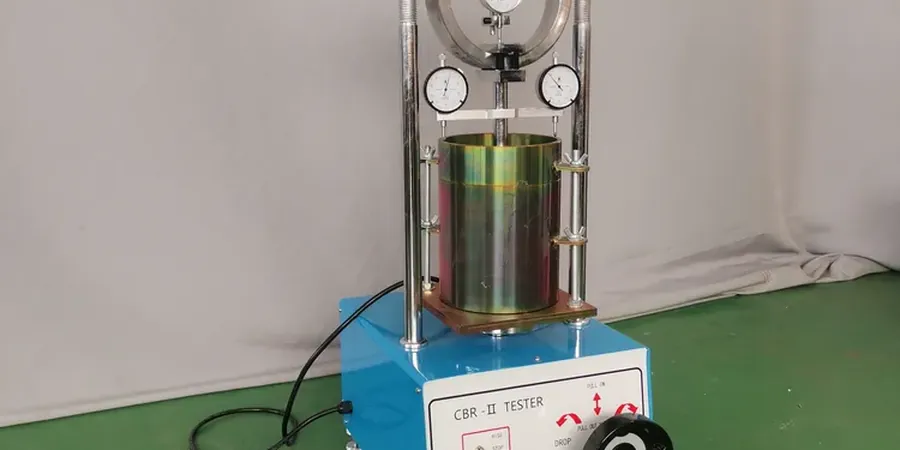
The four-inch diameter steel plunger presses into the compacted soil at a steady 1.27 mm per minute, and the load ring readings start climbing. That is the moment a CBR test tells you whether the subgrade beneath a Milton parking lot or roadway extension can handle the design traffic without rutting. We run the ASTM D1883 soaked procedure as standard because the Halton Till that underlies much of town, with its silt and clay matrix over limestone bedrock, changes dramatically when it takes on water. A dry sample may look firm, but after four days submerged in the soaking tank the bearing capacity often drops to a fraction. Our laboratory in the Greater Toronto Area processes specimens from the Britannia Road industrial corridor, the new subdivisions east of Tremaine Road, and the escarpment transition zones where the overburden thins out. Before committing to a pavement structure, we always cross-check the soaked CBR value against the grain-size distribution and the Atterberg limits because a number alone, without understanding the fines content and plasticity, can mislead the structural design.
A soaked CBR value below 3% on the Halton Till means the pavement design must shift from standard sections to a stabilized platform — ignoring it guarantees premature rutting.
Service characteristics in Milton Ontario
Local geotechnical conditions in Milton Ontario
A 24-unit townhouse development off Thompson Road South specified a parking lot pavement section based on an assumed CBR of 8%. The geotechnical investigation had been skipped to save two weeks on the schedule. Six months after occupancy, the asphalt showed alligator cracking in the first spring thaw, and by the second winter the wheel ruts were ponding water that froze into ice sheets. Core samples confirmed the subgrade was a high-plasticity silt with a soaked CBR of 1.8%. The repair involved full-depth reclamation, import of granular fill to bridge the weak layer, and a 50% cost overrun on the original paving budget. Milton's freeze-thaw cycles, with winter lows routinely hitting minus 20°C and spring temperatures swinging above zero then back below freezing, accelerate the damage when the subgrade lacks bearing strength. A laboratory CBR test, run on representative samples taken during the site investigation phase, would have flagged the problem before the first truck of asphalt arrived.
Our services
Our Milton laboratory runs the full CBR workflow from sample receiving to certified report, typically within five working days. We also provide the companion tests that turn a single CBR number into a complete pavement design package.
Soaked & Unsoaked CBR
Full ASTM D1883 procedure with 96-hour soak, swell measurement, and load-penetration curves for both soaked and unsoaked conditions.
Modified Proctor Compaction
ASTM D1557 compaction curve to establish the maximum dry density and optimum moisture content used for CBR specimen preparation.
Grain Size Analysis
Sieve and hydrometer analysis per ASTM D6913/D7928 to classify the material and verify compliance with OPSS gradation bands.
Pavement Thickness Design Support
We provide the design CBR value and subgrade modulus inputs for AASHTO 1993 or MEPDG pavement structural calculations.
Frequently asked questions
What is the typical turnaround for a laboratory CBR test in Milton?
Standard turnaround is five working days from sample drop-off to certified report. We can expedite to three days when the contractor is waiting to finalize the pavement design and the asphalt plant schedule is tight.
How much does a laboratory CBR test cost in the Milton area?
A single-point soaked CBR test, including the compaction curve, typically runs between CA$180 and CA$250 depending on whether we are testing one sample or a batch from multiple lift thicknesses. Volume pricing applies for larger pavement investigation programs.
Do you need the sample compacted at site moisture, or do you adjust it in the lab?
We condition the sample to the optimum moisture content determined from the Modified Proctor compaction curve. This represents the moisture the contractor targets during field compaction with a smooth-drum roller and water truck, which is the condition the pavement will actually see in service.