Milton sits on the Halton Plain, where glacial till overlies shale bedrock of the Queenston Formation. The overburden here, predominantly Halton Till, is a dense silty clay matrix with embedded clasts. Standard Penetration Test (SPT) data in this region often reveals N-values jumping from 8 in the weathered crust to over 50 at refusal depth, typically within 8 to 12 metres. We run SPT drilling to define that refusal horizon precisely. For sites near the Niagara Escarpment, the till can thin rapidly, exposing fractured shale. Combining SPT readings with a seismic refraction survey lets us map bedrock competency where refusal is shallow, ensuring the foundation design doesn't overlook karst-like voids in the underlying dolomitic limestone layers.
Uncorrected SPT N-values in Halton Till can overstate bearing capacity by a third. Always apply the energy ratio correction before selecting a foundation type.
Service characteristics in Milton Ontario
Local geotechnical conditions in Milton Ontario
A common pattern we see in Milton subdivisions is differential refusal. One borehole hits bedrock at 4 metres; another, twenty metres away, encounters a buried bedrock valley filled with soft glaciolacustrine silt. If the geotechnical report averages those SPT N-values, the foundation design will be dangerously under-conservative for the silt zone. We flag every SPT blow count individually, comparing the sampler recovery and energy ratio against ASTM D1586-18. In areas west of Highway 25, where the till contains artesian water pockets, we also track the drilling fluid return. A sudden drop in return while advancing the SPT sampler often signals a pressurised silt seam that can destabilize an open excavation. For these variable profiles, a CPT test complements the SPT by providing continuous tip resistance, eliminating the data gaps between sampler intervals.
Our services
Every SPT program in Milton is paired with the engineering interpretation that makes the numbers useful for the structural consultant. Here is what the package includes:
Geotechnical SPT Drilling and Logging
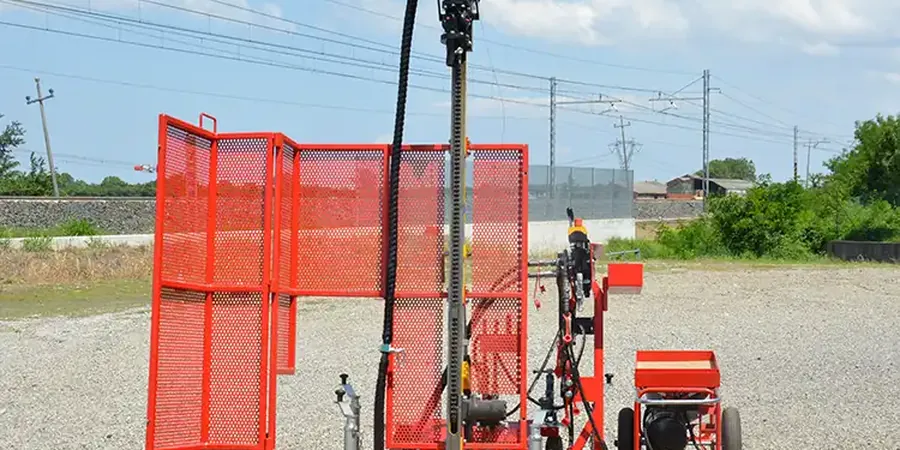
Mobilization with track-mounted or truck-mounted drill rig. Continuous sampling in overburden, with SPT split-spoon every 1.5 m and at stratum contacts. Field log includes moisture, density, consistency, and Modified Burmister classification. Groundwater observations recorded at completion and after 24 hours.
Foundation Design Parameters Report
SPT N60 values corrected for overburden pressure and energy ratio. Factored bearing resistance for shallow footings on till per NBCC 2020 limit states design. Settlement estimates using Schmertmann's method. Liquefaction screening for saturated silt layers using NCEER (Youd & Idriss, 2001) procedure for the Milton seismic hazard spectrum.
Frequently asked questions
What is the cost range for an SPT investigation on a single-family lot in Milton?
For a standard residential lot in Milton, an SPT investigation with two boreholes to 10 metres depth typically falls between CA$750 and CA$880. The range depends on access constraints, the need for a track-mounted versus truck-mounted rig, and whether the site is within a designated natural heritage zone where additional permits apply.
How does the local Halton Till affect SPT N-values?
Halton Till is an overconsolidated glacial deposit with a dense matrix of silty clay and embedded pebbles to cobbles. SPT N-values commonly exceed 50 within 10 metres of grade. The cobble content can cause premature refusal on a single rock fragment. We log the sampler damage and the driller's feel to distinguish cobble refusal from true bedrock refusal, which is essential for accurate foundation depth recommendations.
Can the SPT data be used directly for the Milton building permit submission?
Yes, provided the report meets the Town of Milton's geotechnical submission requirements. The SPT boring logs, N60 corrections, and the foundation bearing resistance statement must be stamped by a Professional Engineer licensed in Ontario. We include the NBCC 2020 seismic site classification based on the average N-value in the upper 30 metres or the measured shear wave velocity where available.