A 6-level underground parking structure off Main Street hit running sand at 9 meters. The contractor called us at 11 p.m. The excavation had started to ravel behind the soldier piles. Milton sits on Halton Till—dense, silty clay till with pockets of sand and silt from the former glacial Lake Iroquois. These pockets shift. They don't warn you. Our team redesigned the bracing spacing overnight, added a waler level, and the excavation stabilized by morning. This is the reality of deep excavation work in Milton: the till is competent until it isn't. We run base stability checks using modified Terzaghi bearing factors adapted for stiff fissured clay. We also combine this with slope stability analysis for adjacent embankments along the escarpment edge, and we specify excavation monitoring when shoring is within 3 meters of existing structures on Ontario Street.
Halton Till stands up steep—until it hits a silt seam. Then it doesn't. That's why we design for the seam, not the average.
Service characteristics in Milton Ontario
- Soldier pile and lagging design to CSA A23.3
- Internal bracing with pipe struts per AISC 360
- Base heave analysis using Bjerrum and Eide (1956) for deep cuts in clay
- Dewatering assessment with MODFLOW for perched water in the till
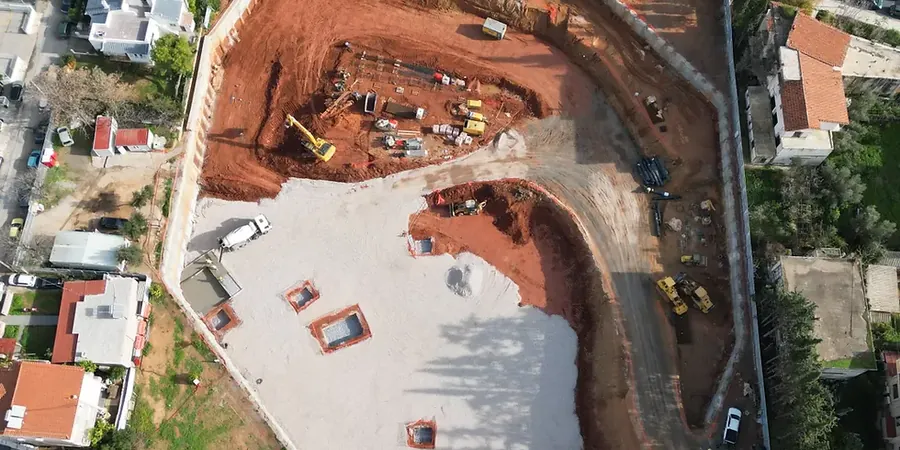
Local geotechnical conditions in Milton Ontario
Milton's Halton Till has an undrained shear strength that can exceed 150 kPa—but the real risk is the silt and fine sand lenses deposited during glacial meltwater events. These lenses carry perched groundwater. You hit one at 8 meters depth on a dry site and suddenly you have a boil in the base. The till matrix is low permeability (10^-7 to 10^-9 cm/s), so the water sits trapped. When the excavation cuts into the lens, the hydraulic gradient reverses. We model these conditions explicitly. A base heave failure in stiff clay can occur without warning—the Bjerrum-Eide analysis is not optional here. Hydrostatic pressure in a sand lens can reduce the factor of safety from 2.5 to 1.1 in a single shift. If you're excavating near the Niagara Escarpment's influence zone, the jointed dolostone of the Lockport Formation sits below the till—and it transmits regional groundwater pressure upward. That changes everything.
Our services
We deliver the engineering package that takes a deep excavation from concept to permit in Milton. No fillers, no generic reports.
Shoring wall design
Soldier pile walls, secant piles, and tangent pile walls designed for Halton Till conditions. Deflection predictions with Plaxis models calibrated to local pressuremeter data.
Anchored and braced systems
Post-grouted ground anchors with bond stress verification. Internal pipe bracing design with AISC 360 compliance and thermal stress compensation.
Base stability assessment
Heave analysis for cuts in stiff clay using Bjerrum-Eide and modified Terzaghi methods. Uplift calculations for confined aquifers below the till.
Dewatering and groundwater control
Perched water management plans. Wellpoint systems and deep well design with MODFLOW modeling for excavations below the local water table.
Frequently asked questions
What is the typical bond stress for ground anchors in Milton's Halton Till?
For post-grouted anchors installed with neat cement and a minimum grout take of 50 kg/m, the bond stress typically ranges from 150 to 250 kPa. We verify this on site with sacrificial test anchors before production installation. The till is stiff and overconsolidated, so bond values are reliable—unless you hit a silt seam, in which case the bond can drop below 100 kPa and we switch to a longer bond length or a double-corrosion-protected strand.
How much does a deep excavation design package cost in Milton?
Design packages range from CA$2,870 to CA$10,470 depending on excavation depth, shoring system complexity, and proximity to neighboring structures. A standard 3-level excavation with soldier piles and tiebacks typically falls in the CA$4,500–CA$6,500 range. Projects requiring full Plaxis 3D analysis with staged construction modeling and groundwater coupling are at the upper end of the range.
Do you handle permit applications for deep excavations in Milton?
Yes. We prepare the geotechnical design report and shoring drawings stamped by a Professional Engineer licensed in Ontario. The Town of Milton requires sealed submissions for excavations deeper than 3 meters or within the zone of influence of public infrastructure. We coordinate directly with the building department and provide responses to plan review comments.
How do you handle the perched water in Halton Till during excavation?
We model the perched lenses explicitly using borehole data and CPT pore pressure dissipation tests. When a sand or silt lens is identified within the excavation depth, we design a localized wellpoint system or horizontal drains to depressurize the lens before the cut reaches it. Passive relief drains behind the shoring are also specified when the lens extends behind the wall. The goal is to eliminate the hydrostatic pressure that causes base instability.
What safety factor do you use for base heave in Milton excavations?
We apply a minimum factor of safety of 1.5 for temporary excavations and 2.0 for permanent structures, following CFEM recommendations. The analysis uses the Bjerrum and Eide (1956) method for deep cuts in clay, adapted for the stiff fissured nature of Halton Till. If a confined aquifer is present below the till, we run a separate uplift check with a factor of safety of 1.3 minimum.