We have seen the same scenario unfold too many times in Milton: a contractor completes a parking lot subgrade on the silty clay till that blankets much of Halton Region, runs nuclear density tests, and everything passes at 98 percent. Three months later, after a wet spring, the asphalt shows settlement cracks and the owner is demanding answers. The problem was never the compaction effort on site. The reference density was wrong. If the Proctor test used in the lab does not represent the actual fill material being placed, every field density number that follows is meaningless. This is where combining a proper grain size analysis early in the project saves thousands in remedial work, because knowing the gradation determines whether you should be running Standard or Modified Proctor in the first place.
A Proctor curve is only as good as the sample it was run on. If the lab material does not represent what the scraper is placing, the density test is just a number on a sheet.
Service characteristics in Milton Ontario
The test itself measures the relationship between moisture content and dry density for a given compactive effort, producing the classic bell-shaped curve that defines optimum moisture content and maximum dry density. What matters on a Milton site is how that curve is applied: if the lab sample is dried and reprocessed differently than how the material behaves in the field, the reference density will not match reality. Our technicians follow ASTM D1557 and D698 procedures explicitly, including the method A, B, or C mold selection based on particle size, and we report the zero-air-voids curve on every graph so the field engineer can immediately spot a questionable point.
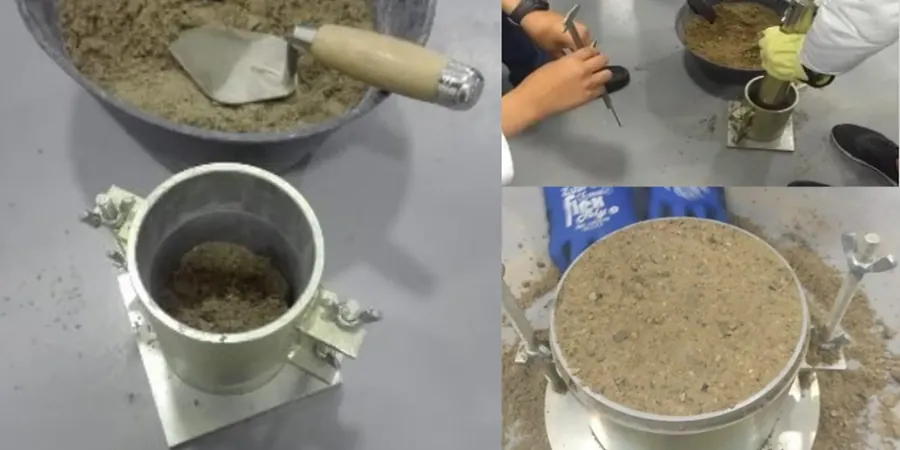
Local geotechnical conditions in Milton Ontario
A seven-story residential building on Thompson Road was nearing foundation approval when the geotechnical inspector flagged low relative compaction on the bearing stratum — a reworked silty clay fill that had been placed during wet weather the previous November. The original Proctor had been run on a sample taken in August from a different lift, when the material was drier and contained more granular fraction from a borrow source that had since changed. The reference maximum dry density was too high, so field densities appeared to fail even though the fill had been compacted with proper equipment and moisture conditioning. The result: two weeks of delays while we ran a new Modified Proctor curve on representative material from the actual lift in question, followed by re-testing of the entire pad. The cost of the lab test was under three hundred dollars. The delay cost the developer far more. When fill sources change, when the season shifts from dry summer to wet fall, or when excavation crosses a contact between till and glaciolacustrine silt, the Proctor reference must be re-established. There is no shortcut around this. A single curve cannot govern an entire Milton site that spans multiple soil units.
Our services
Our Proctor testing is part of a broader compaction control workflow that starts with material characterization and ends with field density correlation. For Milton projects, we typically deliver the following:
Standard and Modified Proctor Curves
Complete moisture-density relationship testing using the 4-inch or 6-inch mold per ASTM D698 or D1557, with method selection based on particle size of the fill material. Each report includes the compaction curve, zero-air-voids line, optimum moisture content, maximum dry density, and the specific method reference so the field technician has full traceability.
One-Point Proctor for Rapid Field Verification
When fill sources change mid-project or weather conditions alter material moisture significantly, we can run a one-point Proctor using the established family of curves to verify that the reference density is still valid, providing same-day turnaround during active earthworks.
Frequently asked questions
What is the difference between Standard and Modified Proctor, and which one does my Milton project need?
Standard Proctor uses a 5.5-pound hammer dropped 12 inches, producing 12,400 ft-lbf/ft³ of compactive effort. Modified Proctor uses a 10-pound hammer dropped 18 inches, producing 56,000 ft-lbf/ft³. For most structural fill under footings, slabs, and road subgrade in Milton, OPSS 206 requires Modified Proctor. Standard Proctor is sometimes appropriate for landscaping fills, trench backfill in non-structural zones, or soils with high plasticity where Modified effort would not represent achievable field compaction.
How much does a Proctor compaction test cost in the Milton area?
A Standard or Modified Proctor test typically ranges from CA$150 to CA$320 depending on whether it is a full five-point curve or a one-point verification, the mold size required, and the turnaround time. We provide a firm quote after confirming the material type and the applicable specification.
How long does it take to get Proctor test results?
A standard five-point Proctor curve generally takes two to three working days from sample receipt, because each point requires moisture conditioning and overnight drying for accurate moisture content determination. We can expedite to next-day reporting when the project schedule demands it, and one-point verifications can often be turned around same-day if received before noon.
Do I need a new Proctor test if the fill material looks the same as the last lift?
Visual similarity is not reliable. If the borrow source changes, if excavation crosses a stratigraphic boundary, or if the material's gradation or plasticity shifts noticeably — which happens frequently in Milton's glacial till and glaciolacustrine deposits — the maximum dry density and optimum moisture content can change enough to invalidate field density acceptance. We recommend re-running the Proctor whenever the material source or soil classification changes.