Milton’s transformation from a quiet mill town on the Niagara Escarpment into one of Canada’s fastest-growing communities has pushed infrastructure into geologically complex terrain. The 401 corridor expansion and the Milton Education Village sit atop a blanket of Halton till—dense, silty clay with sand lenses and fractured shale of the Georgian Bay Formation. When a dewatering plan for a 10-metre excavation on Bronte Street failed in 2019 because lab tests overestimated the till’s permeability by an order of magnitude, the contractor learned what local geotechnical teams already knew: remoulded samples don’t capture fractures. Field permeability testing with the Lefranc method gives us a direct measurement of in-situ hydraulic conductivity in soil, and the Lugeon test quantifies rock mass permeability through packer-isolated intervals. We run these tests alongside SPT drilling to correlate blow counts with water-bearing zones, and the data feeds directly into transient groundwater models for shoring design. With a population approaching 150,000 and the CN intermodal hub driving warehouse construction, Milton demands subsurface data you can stake a pump curve on.
A 1,000-fold permeability contrast across 3 metres of Halton till—that’s why remoulded lab samples fail and why a Lefranc test pays for itself in pump sizing.
Service characteristics in Milton Ontario
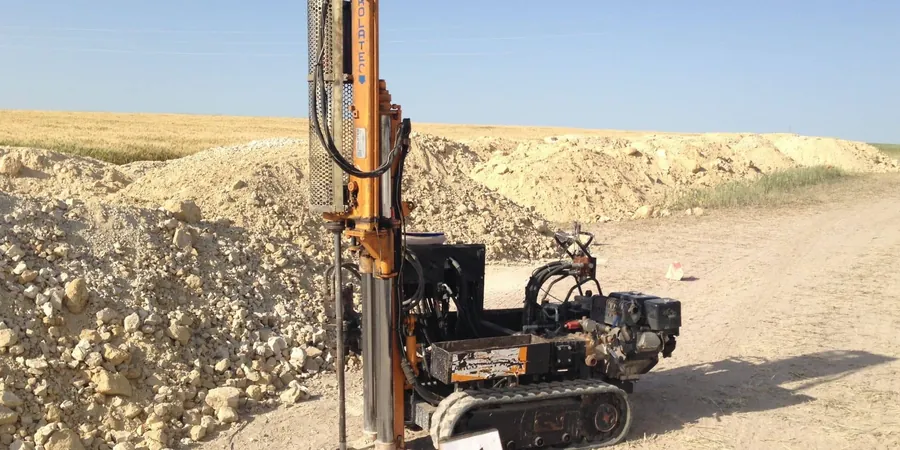
Local geotechnical conditions in Milton Ontario
A six-storey medical office building on Tremaine Road had its shoring permit held up because the hydrogeological model relied on a textbook permeability value for clay till—roughly 1×10⁻⁶ cm/s. The actual Lefranc test in a sand interbed showed 3×10⁻⁴ cm/s, quadrupling the required dewatering capacity. That’s not a paperwork detail; it’s the difference between six wellpoints and twenty-four. Underestimating permeability in Milton’s till means excavation flooding, base heave, and settlement of adjacent footings. Overestimating it in rock—where Lugeon values below 3 Lu are common in competent shale—leads to oversized pumps and unnecessary grouting that burns contingency. The worst scenario we see is a project that skips field testing entirely, relies on grain-size correlations, and then hits an open joint set in the shale that delivers 30 L/min into a footing excavation. That’s a schedule delay measured in weeks, not days. A proper permeability test program, sequenced with the borehole investigation, is the cheapest insurance against groundwater surprises in Halton Region.
Our services
Our Milton field permeability program covers the full groundwater characterization workflow, from borehole drilling to final report. Each test is executed by a two-person crew with a geotechnical engineer on site to adjust the program in real time based on stratigraphy.
Lefranc constant-head tests
In-situ hydraulic conductivity measurement in soil and weathered rock using a cased borehole and a calibrated test section. We apply Hvorslev’s shape factors for cylindrical intakes and report k in cm/s with full time-drawdown curves.
Lugeon packer tests in rock
Multi-stage pressure testing in NQ or HQ coreholes with a pneumatic single or double packer. We record pressure, flow, and packer inflation data at five pressure steps, compute Lugeon units, and interpret fracture flow regime (laminar, turbulent, dilation, washout).
Dewatering design input package
Combined permeability dataset with boring logs, grain-size curves, and a conceptual hydrostratigraphic model. Includes Transmissivity estimates for aquifer layers and recommendations for wellpoint spacing or deep-well pump selection per MOECC Guideline B-7.
Frequently asked questions
What’s the cost of a field permeability testing program in Milton?
For a typical program with two Lefranc tests and one Lugeon test in the same borehole, budgeting CA$960 to CA$1,420 is realistic. The final figure depends on mobilization distance, borehole depth, and the number of test intervals. A site-specific quote based on your borehole layout will always be more accurate than a generic number.
When should we use the Lugeon test instead of the Lefranc method?
The Lugeon test is designed for rock where the borehole can support an inflated packer without collapse. In Milton, we switch to Lugeon as soon as the auger refusal hits the Georgian Bay shale, typically 8 to 15 metres below grade. The Lefranc method works in soil and completely weathered rock where a slotted casing maintains the test section. If your excavation base is in rock, the Lugeon test is the standard.
How long does a single Lefranc test take on a Milton site?
With a pre-drilled borehole and proper setup, a constant-head Lefranc test takes 60 to 90 minutes per interval. That includes saturating the test section, establishing steady flow, and recording the stabilization data. If we’re testing multiple horizons in one borehole—say a sand lens at 4 m and the till matrix at 7 m—count on half a day for two tests plus drilling time between them.