A six-story mixed-use structure on Main Street East needed a foundation that could handle 40 feet of silty clay before hitting shale. That is the reality of building in Milton. The Halton Till dominates our subsurface; dense, overconsolidated silts and clays left by the glaciers, sitting atop the Georgian Bay Formation shale. Shallow footings struggle here once loads exceed three stories. We design deep foundations that transfer structural loads past the compressible upper layers into the bedrock or a competent bearing stratum. Our team applies site-specific geotechnical data from in-situ permeability testing and triaxial shear strength analysis to determine shaft friction and end-bearing capacity. Milton is growing fast, with over 140,000 residents, and the pressure on land means developers are building on marginal sites that demand pile solutions. We work directly with structural consultants to deliver NBCC-compliant pile designs that match the real ground conditions, not just the assumptions from a regional map.
Socketing piles into weathered Georgian Bay shale without a thorough assessment of the rock quality designation (RQD) is the most common source of pile over-design in Milton.
Service characteristics in Milton Ontario
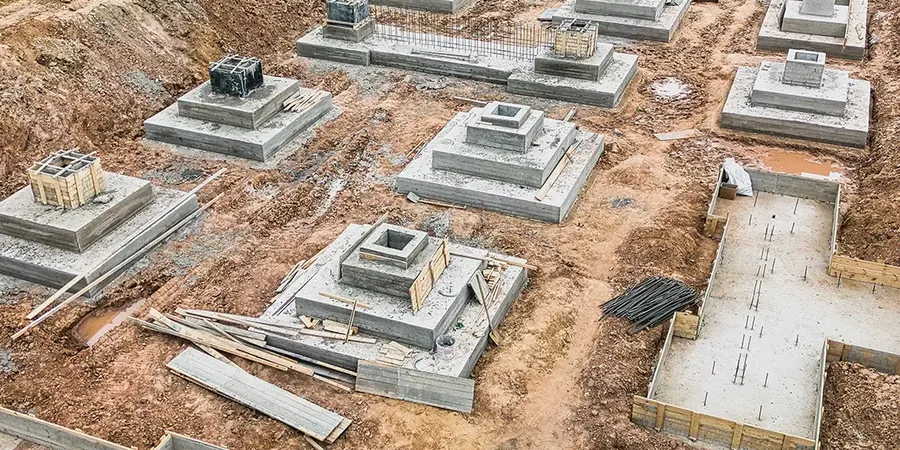
Local geotechnical conditions in Milton Ontario
The drill rig arrives on site: a track-mounted rotary unit with a torque head capable of coring through shale. In Milton's residential subdivisions, space is tight, and overhead hydro lines are a constant obstacle. The biggest risk we mitigate is pile heave during casing installation through the dense till. If the casing is not advanced carefully, it can displace the soil laterally and lift adjacent fresh concrete, creating a void under the pile tip. We specify a minimum distance between freshly cast piles of five diameters center-to-center. Another risk is artesian conditions in the fractured shale, which can cause water to rise inside the drilled shaft and contaminate the concrete pour. Our designs include a contingency for tremie placement if groundwater inflow exceeds 50 mm per minute. On sites near the escarpment, we also evaluate lateral soil movement using inclinometer data from past projects in Milton, ensuring the piles can tolerate the long-term creep of the weathered shale slopes.
Our services
Our pile foundation services in Milton cover the full design lifecycle, from concept to construction support.
Geotechnical Investigation for Pile Design
Borehole drilling, SPT N-value logging, and laboratory testing of the Halton Till and shale to develop design parameters for shaft friction and end bearing.
Pile Capacity and Settlement Analysis
Static analysis using FHWA drilled shaft methods and CPT-based methods where applicable. We provide axial capacity curves and group settlement predictions under service loads.
Pile Load Test Supervision and Interpretation
On-site management of static load tests or PDA testing, with back-analysis to refine the design and confirm the constructed pile meets the required factor of safety.
Frequently asked questions
How much does a pile foundation design cost for a project in Milton?
For a typical mid-rise project in Milton, the geotechnical investigation and pile foundation design package ranges from CA$2,540 to CA$9,490, depending on the number of boreholes, the complexity of the site, and whether a load testing program is required.
What type of pile is most suitable for the soil conditions in Milton?
Drilled shafts (caissons) are the most common choice for buildings over three stories in Milton. They can penetrate the dense Halton Till and socket into the Georgian Bay Formation shale efficiently. For lighter structures or sites with limited headroom, helical piles or driven steel H-piles can be effective alternatives, provided a proper geotechnical investigation confirms the bearing stratum is reachable.
Why can't I use shallow footings for my building in Milton?
Shallow footings can work for low-rise, lightly loaded structures, but the upper layers of silty clay till in Milton are prone to long-term consolidation settlement. For loads exceeding the bearing capacity of the till, or where total settlement must be kept under 25 mm, deep piles are required to transfer the load to the underlying shale bedrock. A site-specific investigation is the only way to make that determination accurately.