A four-storey residential building off Thompson Road was sitting on twelve metres of soft clay, and the settlement estimates from the first round of SPT data made the structural engineer step back. The developer needed a solution that would not blow the schedule, and we proposed vibro-replacement columns under a rigid mat. That job from 2019 still gets brought up in the office because the post-construction settlement measured less than 8 mm after two winters. In Milton, where the glacial lake deposits of the former Lake Peel blanket much of the south and east, stone columns are often the most practical way to transfer loads past the compressible crust without deep excavation. Our technical team handles everything from the preliminary SPT drilling campaign to the final load test, working within Ontario Building Code requirements and CSA A23.3 for concrete caps.
In Milton's glaciolacustrine silts, a well-spaced stone column grid can cut total settlement by half compared to an untreated raft footing.
Service characteristics in Milton Ontario
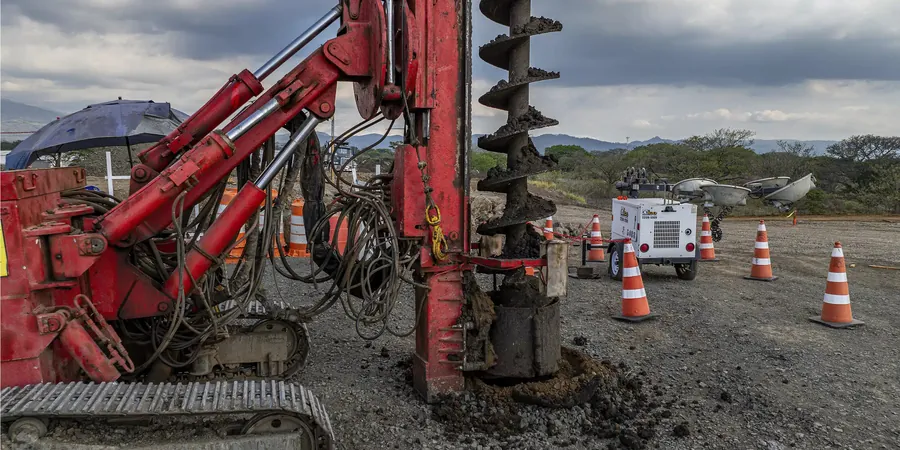
Local geotechnical conditions in Milton Ontario
Milton sits at roughly 200 m elevation on the brow of the Niagara Escarpment, and the transition from shallow dolostone bedrock in the north to deep glaciolacustrine silts in the south creates a geotechnical boundary that catches engineers off guard. The 2021 tremblor near Buffalo reminded everyone that seismic demand in Halton Region is not zero. Stone column design here must account for two failure mechanisms that often overlap: excessive static settlement in the normally consolidated silts and cyclic softening during a moderate earthquake. We run liquefaction triggering analyses using SPT-based correlations from Youd-Idriss (2001) and Seed et al. (2003), then size the column grid to keep post-treatment factor of safety above 1.3. A drainage blanket of at least 300 mm is non-negotiable when columns are installed below the water table, otherwise the excess pore pressure has nowhere to dissipate during the first few months of service loading.
Our services
Our Milton projects typically combine design with field verification because the ground conditions shift quickly across the 401 corridor. The two core services below are what most developers and structural firms request from the start.
Vibro-replacement feasibility and numerical modelling
We run axisymmetric and plane-strain PLAXIS models calibrated to local SPT and CPT data to estimate settlement reduction, bulging failure depth, and radial stress distribution. Each model is tied to a specific column grid, and we provide the structural engineer with a subgrade modulus that reflects the improved ground.
Field QA/QC and modulus verification testing
During installation we log amperage, stone consumption, and backfill drop per metre of column. After curing, we perform zone load tests on single columns and column groups, using a reaction frame sized for 200 % of the working load. The results feed directly into the final foundation design.
Frequently asked questions
How much does stone column design and installation cost per linear metre in Milton?
For a typical vibro-replacement project in the Halton Region, the combined design, mobilization, installation, and load testing falls between CA$1,710 and CA$7,560 per column, depending on depth, aggregate source distance, and whether the site is open or constrained. Shorter columns under 6 m sit at the lower end, while deeper installations through soft clay with high groundwater push toward the upper range.
Can stone columns replace deep piles in Milton's soft clays?
They can, up to a limit. For buildings under about 12 storeys with column loads below 1,500 kN, a stone column grid beneath a rigid raft often eliminates the need for driven piles or caissons. The key is the undrained shear strength of the surrounding clay: we need at least 15 kPa to develop adequate lateral confinement. Below that threshold, the columns lose their bulging resistance and deep foundations become necessary.
What verification testing do you perform after stone columns are installed?
We run plate load tests on at least one column per 50 installed, plus a zone load test on a group of three columns if the building footprint exceeds 500 m². Each test follows ASTM D1194 with a maintained-load protocol over four cycles. We also extract one column every 30 to visually confirm continuity and diameter, and cross-check with CPT soundings between columns to verify the improvement ratio.